Part 1: WHERE ARE WE GOING?
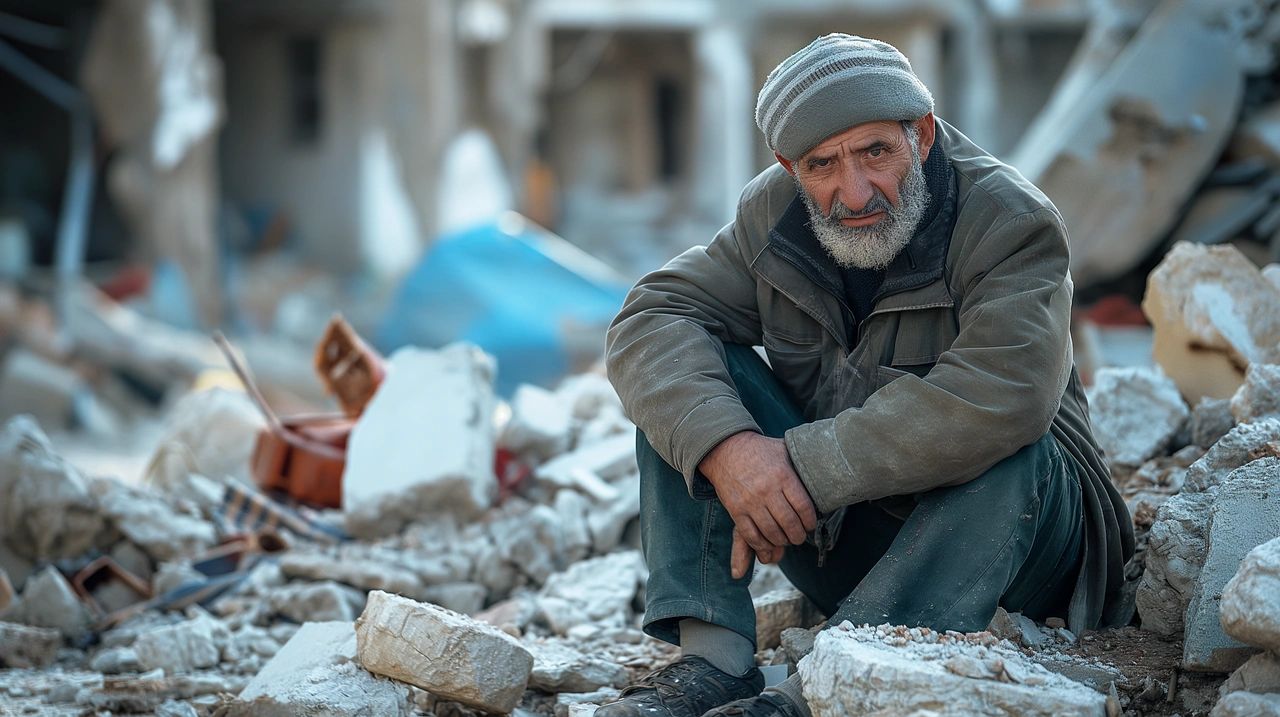
The international humanitarian sector is in crisis. The Secretary General of the United Nations stood before a national border that was shut to prevent humanitarian aid from reaching a million women, children, and civilians, starved of food and water, who are seeking whatever safety they can find amidst the rubble of bombarded homes, schools, and hospitals. Humanitarian aid workers have been killed while trying to provide some relief to these beleaguered people in Gaza. UN relief agencies are finding it impossible to operate there. The Secretary General’s pleas for a ceasefire to prevent further deaths of malnourished children and civilians needing medical assistance have not been responded to so far by the nations that have the power to enforce a ceasefire and open up the flow of aid.
Global governance has collapsed. The national government responsible for the decimation of innocent lives and prevention of the relief has even called for the removal of the Secretary General. Powerful nations who have the power to prevent the blockade have so far not stood with the UN Secretary General or sanctioned the perpetrator.
The UN and its agencies were created after the Second World War to create a more just global order, prevent further violent conflicts, and to provide humanitarian aid wherever required. This is not happening. The time has come for the powers that control international governance institutions to respond to the demands of the many less powerful nations to think again about the purpose of the UN Security Council, the WTO, and the ICJ. They were not set up to just maintain order, but to create a new just order.
International Non-Government Organizations (INGOs) in the humanitarian sector are also in a governance crisis, and have a moral crisis too. A foundational principle for international governance is the principle of liberation: the right of every individual—whatever their race, or religion, or sex, or economic status—to be who they are and lead their lives as they want to so long as they do not harm others. Applying this principle to nations, the UN charter says that every government is sovereign within its national boundaries, within which the people can choose how they want to be governed, and no country has the right to interfere with the rights of people in other countries to form their own governments. However, this principle is contradicted whenever one country interferes with the governance of another to support its views on how universal rights of citizens should be interpreted and implemented.
International NGOs have great difficulty in honoring both principles—freedom of individuals and the freedom of governments in all countries to govern—because the funds INGOs get for their work, and their licenses to operate, are given by the wealthier and more powerful countries. These countries provide development assistance not entirely for altruistic purposes, but also as expressions of their “charitable” power over others. Who pays the piper calls the tune. Thus, humanitarian organizations, including the UN, are dragged into geo-political conflicts.
“Local systems solutions for global systemic problems”. Humanitarian organizations need a new theory of change and a new theory of development to guide their work. If, as it must be, solutions should be found by local people, and they must be empowered to and enabled to implement their rights to find their own solutions.
Moreover, solutions to the global systemic problems listed in the 17 SDGs cannot have universal, standard solutions: “one size cannot fit all”. Because systemic problems, such as environmental degradation, deteriorating sources of livelihoods, poor health, etc. take different forms in different places. Further, such problems do not exist in isolation of each other, and cannot be solved separately. They require local systems solutions cooperatively developed and implemented by communities themselves. Whereas scientific experts and NGOs tend to focus on one or two issues only for which they provide advice and financial assistance to local communities: climate experts for climate issues; health experts for health issues; women’s organizations for women’s issues, etc. Localization must drive the missions of all development organizations and their theories of change.
Mahatma Gandhi provided two principles for those who wish to make the world better for everyone. One was his talisman for all policymakers, NGOs, and even business leaders who want to make the world more fair and better for everyone. One was the principle of anantodaya. “I will give you a talisman,” he said. “Whenever you are in doubt, or when the self becomes too much with you, apply the following test. Recall the face of the poorest and the weakest man or woman whom you may have seen, and ask yourself, if the step you contemplate is going to be of any use to him or her. Will he (she) gain anything by it? Will it restore him or her control over his or her own life and destiny? In other words, will it lead to swaraj (self-governing freedom) for the hungry and spiritually starving millions? Then you will find your doubts and yourself melt away.”
Gandhi’s second principle for all change-makers who want to improve the world is “Be the change you want to see in the world”. Leaders and members of INGOs must pause and introspect. What is the change you want to see in the world? How will you embody that change in your own behaviour? Part 2 of this essay is a reflection on these existential questions.
Part 2: BE THE CHANGE YOU WANT TO SEE IN THE WORLD
Tragically the plight of poor Haitians is in the news again. Their country is ravaged by violent gang wars. Public services are non-existent. Citizens have no safety. The country is running out of medicines, food, and clean water. In 2021, a massive earthquake had brought a flood of international non-government organizations (INGOs) and relief workers to Haiti. There were scandals when some foreign humanitarian workers were found exploiting poor Haitian women for sexual favors. Public trust in INGOs broke down. The boards of trustees of some world known INGOs were called to account by the UK Charity Commission.
Around the same time, a white female employee of a UK-based INGO accused her superiors in the UK of sexual harassment. The responsibility of boards of trustees for safeguarding took on a broader definition of safeguarding the recipients of their charity as well as their own employees from exploitation. With this, the training of trustees in “safeguarding” became mandatory. My organization, HelpAge International, a charity registered in the UK, has complied very diligently with these requirements. Our trustees have been trained in safeguarding and the Board receives a report on safeguarding at every meeting.
Safeguarding of the dignity of poorer people—men and women—from the often-well-meaning charity of richer people is especially important for our organization because most of our work is in poorer, ‘developing’ countries, while most of the money we get to support our work comes from wealthy Western countries.
Safeguarding dignity
Prejudices come in many forms: sexism, racism, classism, and casteism. For us in HelpAge, in addition to all these, is “ageism”, whereby older persons are often seen as less worthy in society.
The international movement for women’s rights has become very powerful around the world, as it needs to be, because male superiority is pervasive, embedded in social and political cultures everywhere, and even in venerable religious scriptures.
Women and men must live together in all societies. The concept of equal rights to work with equal dignity continues to be courageously advocated by the feminist movement. Powerful men are punished with public approbation and by courts for “sexist” remarks about women they work with even if no bodily harm is caused.
Racism
Racism often arises when people of different races come together to work and live together. HelpAge International encounters racism in its work in many countries. We are also aware that we may unconsciously bring racist attitudes into our own charitable work in poorer countries.
Whereas feminism affects only women, racism affects both men and women. Men of ‘inferior’ races are deprived of their dignity by men and women of races who have been brought up to believe their own race is superior. The enslavement of black by white people to provide service in their enterprises and in their homes is one of the darkest stains on human civilization. Legal emancipation has not yet given blacks equal social dignity in countries, and they continue to suffer from hidden biases when they work alongside white people even at the same rank.
Classism
Historically, the higher classes are those who did not have to dirty their hands to work and earn. The lower classes must “labor” to earn. Feudal classes own the land the peasants need to labor on to grow food for themselves and their lords. Blue collar workers labor: whereas white collar workers think, own the knowledge, and order blue collar workers. Karl Marx defined capitalist and working classes as those who make profit from property and those who must do work to earn. Hierarchies of work determine classes within organizations. Those who work below those who have the power to give orders to them. Such hierarchies distinguish officers from soldiers, managers from workers, and bosses and secretaries.
Positions in organizations are expected to be filled on “merit” Merit is defined as the capability of the person to work at the level for which the person is being selected. Since it is difficult to objectively measure the merit of every individual, candidates are chosen based on their similarities to those who select them. They believe they were selected for their merits. Their merits were determined by “people like them” who had similar views of merit. Often, they have been to the same schools, have similar cultural histories, and the same skin color.
Philosopher Michael Sandel explains, in The Tyranny of Merit: What has become of the Common Good, the tyranny of merit that has insidiously crept into US society. Richard Reeves, Senior Fellow of the Brookings Institute, who migrated from the UK to the US to escape the classism in British society says he has found the US to be even more classist. In Dream Hoarders: How the American Upper Middle Class is Leaving Everyone Else in the Dust, he endorses Sandel’s thesis with many statistics that reveal how the elite have entrenched themselves in elite universities and amongst prestigious employers and high level policy positions.
In my own country, India, the “top” is much tighter. “Six degrees of separation” is an estimate of sociologists of the degrees of separation of people from each other. It is observed that people are generally six or fewer social connections away from each other, and as a result, a chain of "friend of a friend" statements can be made to connect any two people in a maximum of six steps.
Shashank Mani says in Middle of Diamond India:
“The circle at the top of Top of the Diamond has become cosy and small, its members leaning on each other for economic transactions and relationships….
“A signal of this small and economically successful club comes from the social settings I sometimes find myself in. In a country of 1.4 billion people, it shouldn’t be difficult to find complete strangers. However, in most social settings, I find myself at only a two-or-three-degree separation from others.”
I personally vouch for Mani’s observation. “People Like Us” (which includes me) have been to the same few colleges in our vast country. Amongst us, an even smaller coterie has gone on to elite universities in the West, worked in Western institutions like the World Bank and IMF, and then returned to high positions in India’s policymaking establishment.
Learning to learn
India has long aspired to build a large and competitive manufacturing sector to provide a ladder for its citizens to lift themselves out of poverty by providing them with opportunities to learn new skills and earn better incomes, which the manufacturing sector has provided to millions in other countries who moved out of lower productivity work (and unstable incomes) in agriculture.
Japan performed an industrial miracle after the Second World War. It created a “machine that changed the world”, according to James Womack, Daniel Roos, and Daniel Jones of MIT, the eponymous title of the book they published in 1990. US industry had become the largest and most competitive in the world by the end of the War, with the prowess of its industrial engineers (many educated in MIT) and with automation of its factories. The Japanese reinvented manufacturing by placing their faith in teams of workers who learned together and made continuous improvements to manufacturing processes. These worker-intensive, rather than capital-intensive, production methods enabled many Japanese industries—steel, automobiles, electronics, shipbuilding, etc.—to overtake US and European manufacturers, and created growth of incomes for millions of Japanese citizens, making Japan the first modern, industrial economy outside North America and Europe within a few decades.
I was deputed by my Indian employers, the Tata company that made commercial vehicles, in the 1980s, to study Japanese automobile manufacturing and learn the recipe of its secret sauce. The Honda Motor Company and Tata formed a joint venture to produce passenger cars in India, which would employ Indian engineers and workers in India, and create a lower cost production base for Honda. We would learn together to develop automobiles to meet the needs of customers in India and similar developing countries, which were different to the needs of Honda’s customers in the US and Europe where Honda had already established itself as a formidable competitor to US and European domestic companies.
The secret sauce, as Womack et al described it, was Small Group Activity (SGA), a method applied in all Japanese industries. I observed teams of Japanese engineers, managers, and workers, setting stretch targets for their projects, learning together, gathering information, analyzing it, and experimenting to make continuous improvements. Our Japanese partners explained they wanted to be the “fastest learning” organization in the world. In a competitive world, where many are investing, innovating, and improving, the only sustainable source of competitive advantage is the ability of an organization to learn faster than everyone else. Moreover, it is the only advantage a small organization can have over larger and better resourced competitors to catch up with them, and then stay ahead of them.
The Honda philosophy was that learning must be from “real people”, in “real places”, and about “real things”. Abstractions of numbers by engineers and other experts from reality cannot explain reality fully. Moreover, the jargon of experts makes little sense to the workers who were expected to produce results for their organization by implementing solutions devised by those experts.
All teams were required to be diverse in their composition. People from many allied departments came together—sales managers, production supervisors, and development engineers; as well as juniors and seniors. Within each team the knowledge of all was considered equally worthy. Sometimes, the junior most in rank was chosen as the leader of a project team. Juniors would critique the opinions of their seniors and the seniors would listen. Thus, the experience and knowledge of everybody was combined to produce innovation. Everyone in the team had equal dignity, and their experience and knowledge in different forms was respected.
Casteism
In my country the worth of human beings and their work has been codified in a pernicious caste system. Those with knowledge are the brahmins, the highest caste. They are followed by those who rule. Next are merchants who trade and make profits. The workers are the lowest castes. And those who get their hands dirty to make others’ lives clean, are the lowest, condemned along with their children and grandchildren to live their lives in degrading indignity. Many pernicious rules and invisible barriers are created around them by the superior castes to prevent their uppity aspirations for equality.
“Dalits” are the lowest castes in the Indian social hierarchy (which pervades Hindu, and even Christian and Sikh communities). Dalit women in Indian villages are the most oppressed human beings on Earth, says Ashif Shaikh, a lower caste himself amongst Muslims, who is the founder and current CEO of Jan Sahas, and national convener of Rashtriya Garima Abhiyan (National Campaign for Dignity). Dalit women are given no protection against sexual exploitation by upper class men. Dalit men must allow upper classes to have their pleasure when they will. The police will not help them, nor lawyers. Even doctors will not help their wives. Either the doctors and lawyers are themselves biased, or fearful of upper-class retaliation.
Ashif and his fellow students from similar backgrounds, in a college in a small town in middle India, founded Jan Sahas (the “people’ support movement”) twenty years ago. His mission was to spark self-respect amongst Dalit rape survivors. The Jan Sahas movement, which works in 16000 villages across several states in India, is led by the rape survivors themselves. Volunteer doctors and lawyers enable them to get a fair hearing and to present their evidence to the police and courts. The women guide rape survivors in other villages to become leaders in their own communities, and together they participate in national marches for justice. They don’t want pity or charity. They speak for themselves. They are being heard.
Ageism
The cause of older persons is not a popular cause. It does not tug at hearts like the needs of undernourished and poorly educated children do; or have the scale of movements to uplift women; or the recent urgency of climate change.
Like oil heating around a frog in a vessel, the need for humanity to address ageism is inexorably rising. Demographics changes slowly but surely. It is not easy to reverse. Reducing the numbers of babies born by social and policy measures has improved the well-being of women and accelerated economic growth in many countries. Now, those countries have the systemic problem of an ageing population, with more educated women who do not want to have babies, and fewer youth to grow their economies and support older persons who are living longer.
These countries should welcome migrant workers from poorer countries who are desperate to find decent work to support their families. Many are forced to leave their own countries to escape violence stirred by internal racial tensions, which is sometimes provoked by power struggles amongst wealthy and militarily powerful countries. However, rich countries are building walls against migrants who need humanitarian assistance, fearing they will pollute their societies with their racial and cultural differences.
In the last few years, while HelpAge was exploring how we could help older persons, especially those in developing countries, with our limited resources, we have listened to them more carefully. They do not want to be treated as unaffordable burdens in their communities. They want to be seen as worthy though, or even because they are older. While listening to them, which has been easier when they are together in older persons’ associations, we have learned what they really want. They want more respect for who they are, and for what they can provide others, in return for the care they need as they inevitably age. Inter-generational support groups often build naturally, as we have seen in refugee camps in the Middle East, and around OPAs (older persons’ associations) in Vietnam.
Every human being: man, woman, or other; black, white, or brown; rich, poor, or destitute; formally educated or not; and whatever work they do; is equal to every other in the eyes of God, and in the constitutions of most countries. Therefore, all human beings must be given equal dignity. That is the only way to eliminate the many “isms” of classism, casteism, sexism, racism, and ageism at their roots.
Humanitarian Aid
When the war broke out in Ukraine in 2022, billions of dollars of aid poured in to provide relief and rehabilitation for Ukrainians. Ukrainian migrants were welcomed by the rich countries, and even put ahead of the queues of migrants from other wars. It was heart-warming to see humanity respond to the needs of human beings in great distress. When the war broke out, HelpAge International was proud to be amongst the first responders to provide aid on the ground. We could reach older persons, and women and children, through our local partners and their networks of support for older persons.
In 2023 war broke out in Gaza. Food, water, and medicine was required urgently to save the lives of a million children, women, and older persons, who are being starved to death amidst the rubble of their shattered homes and towns. Supply of relief has been constricted to a trickle. Our local partners on the ground have been unable to function and have lost their own family members. UN and other foreign aid workers are being killed when they heroically risk their lives to provide relief.
Geo-politics, and racial colonisation, seems to have withered the humanity of the great powers. The same countries that had rushed to support women, children, and older persons in Ukraine say their priority is to safeguard the security of the citizens of Israel.
“When will they ever learn?” sang Joan Baez sixty years ago when millions were being slaughtered by US weapons in the killing fields of Vietnam. They have not yet learned.
Moments of truth
A “moment of truth” in marketing is the moment when a customer/user interacts with a brand, product, or service to form or change an impression about that brand, and about the organization marketing it.
An organization’s true values are not what its website says they are. They are what its members practice every day in their encounters with each other and their customers.
A humanitarian organization does not do charity. It gives to others what is their birth right. It gives them their dignity and their right to be treated as equally worthy as its own members.
A truly humanitarian organization or nation does not preach humanity. It practices humanity by safeguarding human dignity in every interaction it has with others and amongst its internal members.
Arun Maira
April 9 th 2024